Lhasa
Apso Breed Standard
The Australian
National Kennel Council
Pre
1987 Kennel Club, London
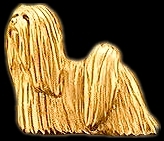
GENERAL APPEARANCE - The Lhasa
Apso should give the appearance of a well
balanced , solid dog.
CHARACTERISTICS - Gay,
assertive, but chary of strangers.
TEMPERAMENT - (Refer
Characteristics)
HEAD AND SKULL - Heavy head
furnishings with good fall over the eyes,
good whiskers and beard. Skull moderately
narrow, falling away behind the eyes in a
marked degree; not quite flat, but not
domed or apple shaped. Straight foreface,
with medium stop. Nose black. Muzzle
about 3.8cm (1 1/2ins) long, but not
square; the length from tip of nose to be
roughly one-third the total length from
nose to back of skull.
EYES - Dark. Medium
sized eyes to be frontally placed; not
large or full, or small and sunk. No
white showing at base or top of eye.
EARS - Pendant,
heavily feathered. Dark tips as asset.
MOUTH - Upper
incisors should close just inside the
lower, i.e. a reverse scissor bite.
Incisors should be nearly in a straight
line. Full dentition is desirable.
NECK - Strong, well
covered with a dense mane which is more
pronounced in dogs than in bitches.
FOREQUARTERS - Shoulder
should be well laid back. Forelegs
straight, heavily furnished with hair.
BODY - The length
from point of shoulders to point of
buttocks greater than height at withers.
Well ribbed up. Level topline. Strong
loin. Well balanced and compact.
HINDQUARTERS - Well
developed with good muscle. Good
angulation. Heavily furnished. The hocks
when viewed from behind should be
parallel and not too close together.
FEET
-
Round
and cat-like, with good pads. Well
feathered.
TAIL - High set,
carried well over back and not like a
pot-hook. There is often a kink at the
end. Well feathered.
GAIT/MOVEMENT
-
Free
and jaunty in movement.
COAT - Top coat
heavy, straight and hard, not woolly or
silky, of good length. Dense undercoat.
COLOUR - Golden,
sandy, honey, dark grizzle, slate, smoke,
part-colour, black, white or brown.
SIZE
-
Ideal
height: 25.4 cm(10ins) at shoulder for
dogs;
Bitches
slightly smaller.
FAULTS - any departure
from the foregoing points should be
considered a fault and the seriousness
with which the fault should be regarded
should be in exact proportion to its
degree.
NOTE - Male animals
should have two apparently normal
testicles fully descended into the
scrotum.
|